Indian Sandstone Patio Installation Cost per m2 UK Guide
Indian Sandstone Patio Installation Cost per Square Metre UK
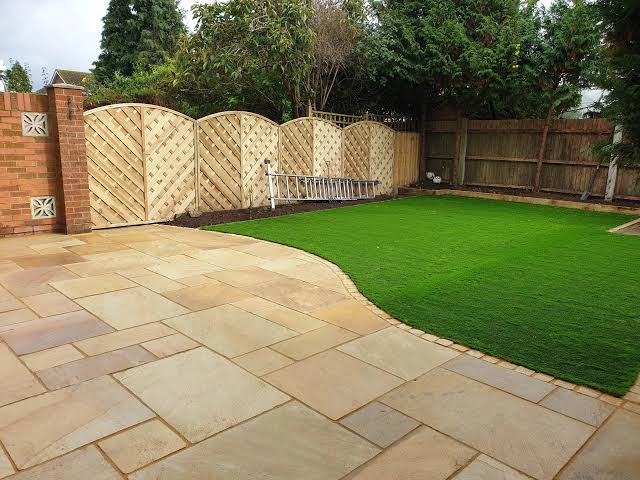
Indian sandstone remains the most sought-after natural stone paving material across British gardens due to its warm color variations, long-term durability, and attractive pricing relative to premium alternatives like granite or porcelain. Selecting sandstone allows property owners to create classic, character-rich outdoor seating areas, dining terraces, and garden pathways that age gracefully under traditional UK weather conditions.
Evaluating the Indian sandstone patio installation cost per square metre UK homeowners encounter requires analyzing multiple project inputs, including raw slab prices, excavation and sub-base preparation, mortar bedding mixtures, slurry primers, and professional landscaping labor. Total installed prices typically range between £100 and £150+ per square meter (m²). This comprehensive guide breaks down stone finishes, installation methods, practical design scenarios, budgeting frameworks, and long-term care guidelines to help property owners plan effectively.
Understanding Indian Sandstone Patio Installation Cost per Square Metre UK
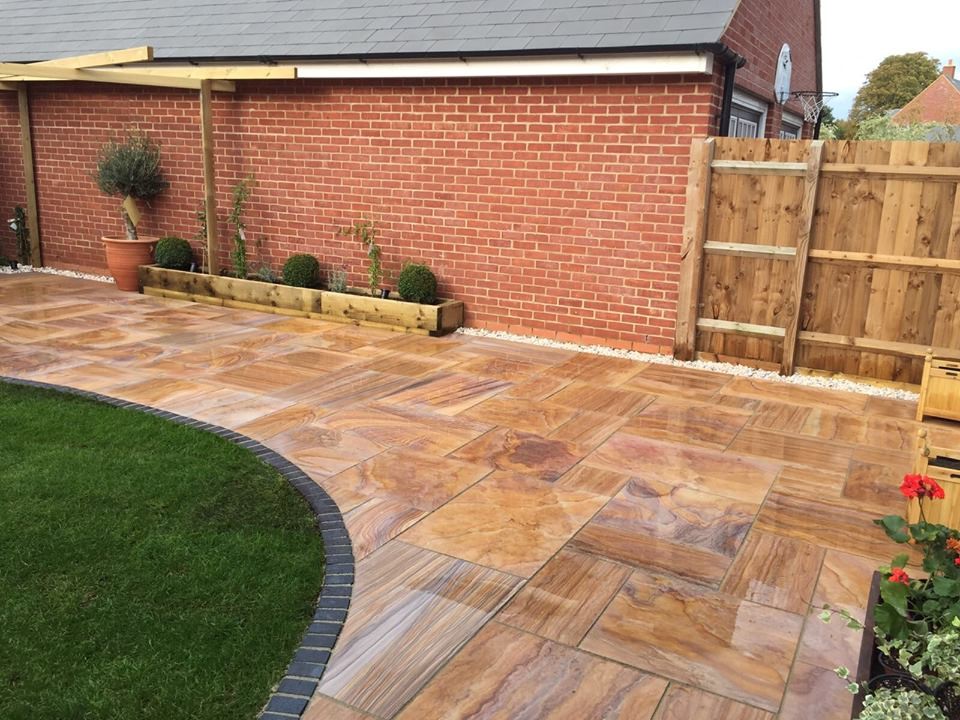
Evaluating the Indian sandstone patio installation cost per square metre UK market involves understanding both raw material processing and structural ground assembly. Indian sandstone is a natural sedimentary rock quarried primarily in Rajasthan, India, and shipped to the UK in calibrated project crates. Material supply costs for standard natural riven sandstone range from £20 to £35 per m², while sawn, honed, or tumbled premium finishes cost between £25 and £50+ per m².
                 INDIAN SANDSTONE PATIO CROSS-SECTION

      [ Surface Layer ]    22mm Calibrated Indian Sandstone Slabs
      === (Joints) ===     Weather-Resistant Resin or Mortar Pointing
      [ Bond Coat ]        Polymer Slurry Primer Layer (SBR Bond)
      --------------------------------------------------------------------------
      [ Bedding Layer ]    30mm - 50mm Full Wet Mortar Bed (4:1 Sharp Sand/Cement)
      ..........................................................................
      [ Sub-Base Layer ]   100mm - 150mm Compacted MOT Type 1 Aggregate
      ~~~~~~~~~~~~~~~~~~~~~~~~~~~~~~~~~~~~~~~~~~~~~~~~~~~~~~~~~~~~~~~~~~~~~~~~~~
      [ Filter Layer ]     Non-Woven Geotextile Membrane
      ~~~~~~~~~~~~~~~~~~~~~~~~~~~~~~~~~~~~~~~~~~~~~~~~~~~~~~~~~~~~~~~~~~~~~~~~~~
      [ Subgrade Soil ]    Excavated Native Soil (Graded to 1:60 Drainage Fall)
A structurally sound installation requires more than simply placing slabs on topsoil. A complete patio assembly consists of a non-woven geotextile membrane, a 100mm to 150mm compacted sub-base of MOT Type 1 crushed aggregate, a 30mm to 50mm full wet sand-and-cement mortar bed (4 parts sharp sand to 1 part Portland cement), SBR polymer slurry primer on the back of each slab, and joint pointing mortar. Contractor labor and ground preparation typically account for £70 to £110 per m² of the total invoice, bringing the combined all-in installed cost to £100–£150+ per m².
Key Categories, Material Options, and Types
When evaluating the Indian sandstone patio installation cost per square metre UK options, stone formats, surface textures, and edge processing significantly influence both raw material purchase prices and installation speeds.
| Category / Type | Description | Common Use Case | Time / Cost / Effort Level |
| Standard Riven Calibrated | Naturally split surface texture with hand-split edges; calibrated to a uniform 22mm thickness. | Traditional country gardens, family terraces, and rustic pathways. |
Material: £20–£32 / m² Installed Total: £100–£135 / m² Effort: Moderate |
| Sawn & Honed Smooth | Machine-cut straight edges with a smooth, diamond-honed flat surface finish. | Modern urban courtyards, minimalist patios, and contemporary garden zones. |
Material: £25–£50 / m² Installed Total: £120–£165 / m² Effort: High (requires precise narrow jointing) |
| Tumbled / Antique | Weathered, rounded edges and softened surface texture mimicking aged historic stone. | Period properties, cottage gardens, and traditional courtyard restorations. |
Material: £28–£45 / m² Installed Total: £115–£155 / m² Effort: Moderate-High |
| Random Layout Patio Packs | Crates containing four mixed slab sizes (e.g., 900×600, 600×600, 600×290, 290x290mm). | Creating natural, unaligned random paving patterns without repetitive grid lines. |
Material: £22–£35 / m² Installed Total: £105–£140 / m² Effort: High (laying puzzle-like multi-size patterns) |
| Single-Size Slabs (e.g., 900x600mm) | Uniform slab dimensions laid in continuous staggered stretcher-bond rows. | Modern patio dining spaces requiring clean, parallel visual lines. |
Material: £22–£36 / m² Installed Total: £100–£135 / m² Effort: Low-Moderate (faster daily laying rate) |
How to Choose Between Categories
Selecting an appropriate category depends on architectural style, property age, and budget allocation. Standard riven calibrated patio packs represent the most cost-effective option, offering authentic natural texture and simplified handling. Sawn and honed options suit modern properties but require pristine sub-base leveling and precise wet-saw diamond cuts. Single-size 900x600mm slabs streamline installation labor, whereas multi-size patio packs require additional laying time to arrange mixed dimensions seamlessly across the site.
Practical Scenarios or Thematic Applications
Scenario 1: Standard Suburban Rear Garden Patio (20 m²)
-
Context: Replacing an old concrete slab patio in a flat rear garden with a 20 m² Raj Green or Kandla Grey riven sandstone patio pack.
-
Component List:
-
Concrete slab demolition and waste disposal via skip hire (£250–£350).
-
Soil excavation to a 150mm depth and geotextile membrane placement.
-
100mm compacted MOT Type 1 aggregate base.
-
35mm full wet mortar bed (4:1 sharp sand to cement).
-
SBR slurry primer coat applied to back of all slabs.
-
Calibrated riven Indian sandstone patio pack (£22 / m²).
-
All-weather resin jointing compound swept into 10mm gaps.
-
-
Relevance: Demonstrates a standard residential project where straightforward site access keeps labor output efficiency high, resulting in baseline installed costs (£100 to £130 per m²).
Scenario 2: Sloped Garden with Retaining Steps & Drainage Integration (30 m²)
-
Context: Constructing a terrace on a sloped garden requiring a low retaining wall, integrated steps, and drainage channels.
-
Component List:
-
Machine excavation and earthmoving to create a level subgrade shelf.
-
150mm reinforced MOT Type 1 base aggregate.
-
Concrete block retaining wall with sandstone bullnose coping stones (£80–£180 per linear meter).
-
Linear slot drainage channel installed along house walls, tied into soakaway pits.
-
Autumn Brown riven sandstone slabs on full mortar bed.
-
-
Relevance: Highlights how earth-retaining masonry, drainage infrastructure, and step construction increase specialized labor hours, pushing total project costs to £140–£180 per m².
Scenario 3: Contemporary Townhouse Courtyard with Sawn Sandstone (15 m²)
-
Context: Installing a smooth, modern 15 m² sawn and honed smooth grey sandstone patio in an urban courtyard with narrow access.
-
Component List:
-
Manual waste transit via wheelbarrow through house interior or side passage.
-
100mm compacted sub-base aggregate.
-
Sawn 900x600mm diamond-cut sandstone slabs (£32 / m²).
-
Precision 5mm joints filled with exterior polymer mortar grout.
-
Impregnating breathable stone sealer application (£6–£10 / m²).
-
-
Relevance: Illustrates how restricted site access, sawn material costs, and sealing requirements elevate per-square-meter rates on smaller urban footprints.
                 SCENARIO COMPLEXITY & COST PROFILE

      Standard Rear Patio (20 m²)          Sloped Garden & Drainage (30 m²)
      +----------------------------+      +---------------------------------+
      | Flat Site Access           |      | Excavation Shelf & Retaining Wall|
      | Standard Riven Pack        |      | Integrated Slot Drainage        |
      | National Average Labor     |      | Masonry Steps & Bullnose Coping |
      | £100 - £130 / m² Total     |      | £140 - £180 / m² Total          |
      +----------------------------+      +---------------------------------+
Comparison of Scenarios
Scenario 1 represents the standard benchmark for suburban garden projects, balancing material accessibility with efficient labor timelines. Scenario 2 introduces civil engineering factors—such as soil retention, step building, and surface water management—where structural walling drives overall expenditure. Scenario 3 demonstrates that small urban projects often carry higher per-meter overhead costs due to material transit friction and high-end sawn finishes.
Planning, Cost, or Resource Considerations
Accurately evaluating the Indian sandstone patio installation cost per square metre UK market requires factoring in regional labor rates, aggregate delivery fees, skip hire expenses, and waste management. Landscaping labor in London and South East England commands a 20% to 35% premium over equivalent work in Northern England, Wales, or Scotland.
       TYPICAL INSTALLED COST RANGES PER M² (UK)

  Midlands & Northern England
  [Materials £25-£45] + [Labor & Prep £65-£85]   --->  £90 - £130 / m² Total

  London & South East England
  [Materials £28-£50] + [Labor & Prep £85-£120]  --->  £113 - £170+ / m² Total
Sample Project Budget Model (20 m² Patio, UK Average)
| Category | Cost Range (£) / Effort | Explanation | Optimization Tips |
| Site Excavation & Skip Hire | £300 – £550 | Removal of lawn/concrete to 150mm depth and muck-away skip hire. | Use a grab lorry instead of skips if removing over 8 tonnes of soil. |
| Sub-Base & Mortar Materials | £350 – £600 | MOT Type 1 aggregate, sharp sand, cement, SBR primer, and jointing compound. | Order bulk aggregate bags rather than small 25kg bags to lower material costs. |
| Sandstone Slabs (Supply Only) | £400 – £700 | Calibrated riven or sawn sandstone slabs (£20–£35/m² plus 10% waste allowance). | Buy full crate project packs (approx. 19–20m²) to secure wholesale rates. |
| Installation Labor | £1,000 – £1,800 | Two-person landscaping team for 3–4 days laying, cutting, and pointing. | Clear side passage access prior to contractor arrival to accelerate setup. |
| Impregnating Sealer (Optional) | £100 – £200 | Breathable natural stone sealer application (£5–£10/m²). | Apply sealer after mortar and pointing have cured completely (typically 4–6 weeks). |
| Estimated Total Installed | £2,150 – £3,850 | National average total installed range equates to approx. £105 to £190 per m² all-in. | Note: Figures serve as illustrative baseline examples and vary by region and site conditions. |
Installation Strategies, Tools, and Support Systems
Executing a long-lasting Indian sandstone patio installation requires specific masonry techniques and specialized tools tailored to natural stone properties.
1. SBR Polymer Slurry Bonding Strategy
-
Description: Coating the back of every sandstone slab with a slurry mixture of SBR (Styrene-Butadiene Rubber) and Portland cement before placing it on the wet mortar bed.
-
Advantages: Creates a strong chemical bond, preventing slab delamination caused by freeze-thaw moisture cycles.
-
Disadvantages: Adds £2 to £4 per m² in consumable costs and requires clean handling to avoid staining slab faces.
2. Wet Diamond Blade Cutters
-
Description: Utilizing a water-suppressed angle grinder or table saw fitted with a continuous-rim diamond blade for cutting stone edges.
-
Advantages: Produces clean cut lines, reduces airborne silica dust exposure, and prevents stone cracking.
-
Disadvantages: Requires water supply hookups, specialized safety equipment, and careful wastewater containment.
                 BONDING & BEDDING MECHANICS

        Incorrect "Spot Dab" Method              Correct Full Mortar Bed
      +---------------------------+          +---------------------------+
      | Natural Sandstone Slab    |          | Natural Sandstone Slab    |
      |   (o)     (o)     (o)     |          |===========================| <--- Slurry Primer
      | Air Voids & Water Traps   |          | Solid Wet Mortar Bed      |
      |---------------------------|          |---------------------------|
      | Subgrade Base             |          | Compacted MOT Type 1 Base |
      +---------------------------+          +---------------------------+
      (Leads to reflective stains           (Ensures full load support  )
      (and winter frost cracking )           (and zero water pooling    )
3. Polymeric All-Weather Jointing Resins
-
Description: Ready-mixed brush-in jointing compounds that set hard when exposed to air while remaining permeable to moisture.
-
Advantages: Speeds up pointing labor by 70% compared to traditional trowel pointing and resists weed growth between joints.
-
Disadvantages: Requires continuously wet stone surfaces during application to prevent resin haze stains.
4. Impregnating Breathable Sealers
-
Description: Sub-surface penetrating sealers that line stone pores without forming a glossy plastic film on the surface.
-
Advantages: Repels water, oil, and leaf stains while allowing internal moisture vapor to escape naturally.
-
Disadvantages: Costs £5 to £10 per m² and requires re-application every 3 to 5 years.
Safety, Structural Risks, and Common Pitfalls
Natural sandstone is porous and susceptible to improper installation practices that can cause staining, movement, or winter frost damage.
+------------------------------------------------------------------------+
|                     RISK & FAILURE MITIGATION MATRIX                   |
+------------------------------------------------------------------------+
| ISSUE / RISK       | ROOT CAUSE               | PREVENTION & MITIGATION|
+--------------------+--------------------------+------------------------+
| "Spot Dabbing"     | Laying slabs on mortar   | Always lay slabs on a  |
| Staining & Cracks  | blobs, leaving voids that| 100% solid full wet    |
|                    | trap moisture and salt.  | mortar bed.            |
+--------------------+--------------------------+------------------------+
| Efflorescence &    | Minerals leaching through| Apply SBR slurry primer|
| Moisture Rings     | porous stone from mortar | to slab undersides; use|
|                    | beds lacking primer.     | clean sharp sand.      |
+--------------------+--------------------------+------------------------+
| Surface Water      | Inadequate fall/slope    | Incorporate a 1:60 fall|
| Pooling & Ice      | integrated into patio    | (17mm drop per meter)  |
|                    | grading.                 | away from buildings.   |
+--------------------+--------------------------+------------------------+
| Iron Spot Rusting  | Natural iron deposits in | Use specialist stone   |
|                    | sandstone reacting with  | rust removers; avoid   |
|                    | water or acid washes.    | harsh brick acid.      |
+------------------------------------------------------------------------+
Maintenance & Long-Term Asset Management
Proper ongoing maintenance protects natural sandstone colors, maintains slip resistance, and preserves joint integrity over decades.
                   SANDSTONE 10-YEAR MAINTENANCE TIMELINE

  Installation     Spring Clean         Bi-Annual Check        Year 3 - 5
  [Initial Set] -> [Gentle Wash] -----> [Joint Inspection] -> [Sealer Top-Up]
       |                |                    |                    |
  Verify Curing    Remove Moss &        Check Pointing for   Apply Impregnating
  (4-6 Weeks)      Algae Biofilms       Cracks & Gaps        Sealer Coating
Recommended Maintenance Protocols
-
Seasonal Cleaning (Spring): Wash the patio using warm water, a neutral pH outdoor stone cleaner, and a stiff broom. Avoid using high-pressure jet washers directly over mortar joints, as close-range pressure can erode jointing material.
-
Algae and Moss Removal: Treat shaded garden sections with organic, non-acidic patio cleaners to dislodge green algae biofilms before winter frost arrives.
-
Winter De-Icing Safety: Avoid applying chemical de-icing salts (sodium chloride) to natural sandstone during winter freezes. De-icing salts penetrate porous stone, crystallize inside pores, and cause surface scaling. Use clean sand for winter traction instead.
-
Efflorescence Care: White powdery salt deposits (efflorescence) occasionally appear on new sandstone during initial drying. Brush the surface dry with a stiff broom; do not wash with water, as moisture re-dissolves salts back into the stone.
Project Documentation & Quality Control
Archiving project records protects warranties, simplifies future maintenance, and documents capital property improvements for real estate valuations.
                 PROJECT DOCUMENTATION DOSSIER

  +-------------------------------------------------------------+
  |  1. Itemized Contractor Scope of Work & Payment Receipts    |
  |  2. Stone Delivery Invoices (Quarry, Color, & Crate Batch)  |
  |  3. Technical Data Sheets for Mortar, Primers, & Sealers    |
  |  4. As-Built Photos showing MOT Base Depth & Full Mortar Bed |
  |  5. Written Workmanship Guarantee Certificates              |
  +-------------------------------------------------------------+
Illustrative Documentation Examples
Example 1: Resale Valuation Verification
A property owner installs a 25 m² Raj Green sandstone patio. They assemble a digital dossier containing contractor receipts, MOT Type 1 aggregate delivery tickets, and photos documenting the full mortar bed and slurry primer installation. When selling the property, this proof satisfies the buyer’s surveyor that the patio was laid according to British Standards rather than temporarily spot-dabbed.
Example 2: Batch Matching for Future Extensions
A homeowner builds a 15 m² sandstone dining terrace. Three years later, they decide to extend the patio by an additional 12 m². Because they kept the original crate delivery invoices specifying the quarry source and color batch (“Kandla Grey Calibrated 22mm”), their supplier provides matching stone crates, avoiding color mismatches across the expanded patio.
Closing Summary
Evaluating the Indian sandstone patio installation cost per square metre UK market involves balancing raw material choices against proper site preparation and installation techniques. While raw sandstone materials remain affordably priced (£20 to £50 per m²), achieving a durable patio requires a total installed budget of £100 to £150+ per m² to cover excavation, sub-base compaction, full mortar bedding, slurry priming, and professional labor. By opting for full mortar beds, incorporating appropriate drainage falls, and performing routine seasonal maintenance, homeowners create a character-rich outdoor living space that lasts for decades.
Frequently Asked Questions (FAQ)
What is the average cost per square meter to lay Indian sandstone in the UK?
The total installed cost to lay Indian sandstone in the UK typically ranges from £100 to £150+ per square meter (m²). This price includes raw stone materials (£20–£50/m²), MOT Type 1 sub-base aggregate, mortar bedding, slurry primer, jointing compounds, waste removal, and professional contractor labor.
Is Indian sandstone cheaper than porcelain paving in the UK?
Yes, Indian sandstone is generally 15% to 30% cheaper overall than porcelain paving. Raw sandstone materials (£20–£35/m² for standard riven) are less expensive than quality 20mm porcelain slabs (£30–£60+/m²), and sandstone installation requires fewer specialized tile leveling clips and diamond cutting blades.
Should Indian sandstone be sealed after installation?
While sealing is not strictly mandatory, applying a breathable impregnating sealer (£5–£10/m²) is strongly recommended. Impregnating sealers protect porous sandstone from leaf tannins, moss growth, oil stains, and frost damage without trapping moisture vapor inside the stone.